SCHOOL-LED TECHNOLOGY
Keep educational judgement at the centre.
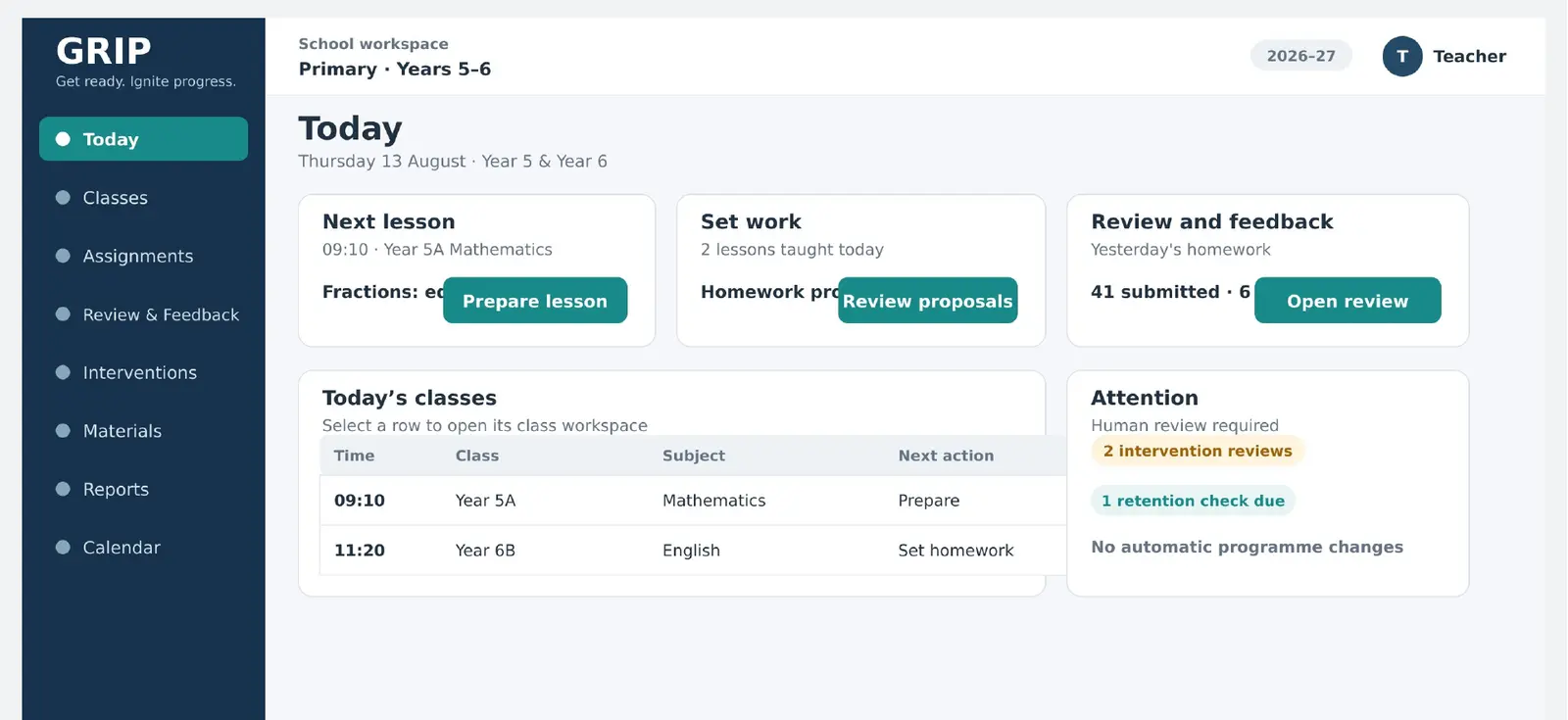
Useful AI support needs clear boundaries. GRIP’s approach places approved materials, progressive guidance, teacher authority and appropriate access within the learning process.

Begin with approved materials
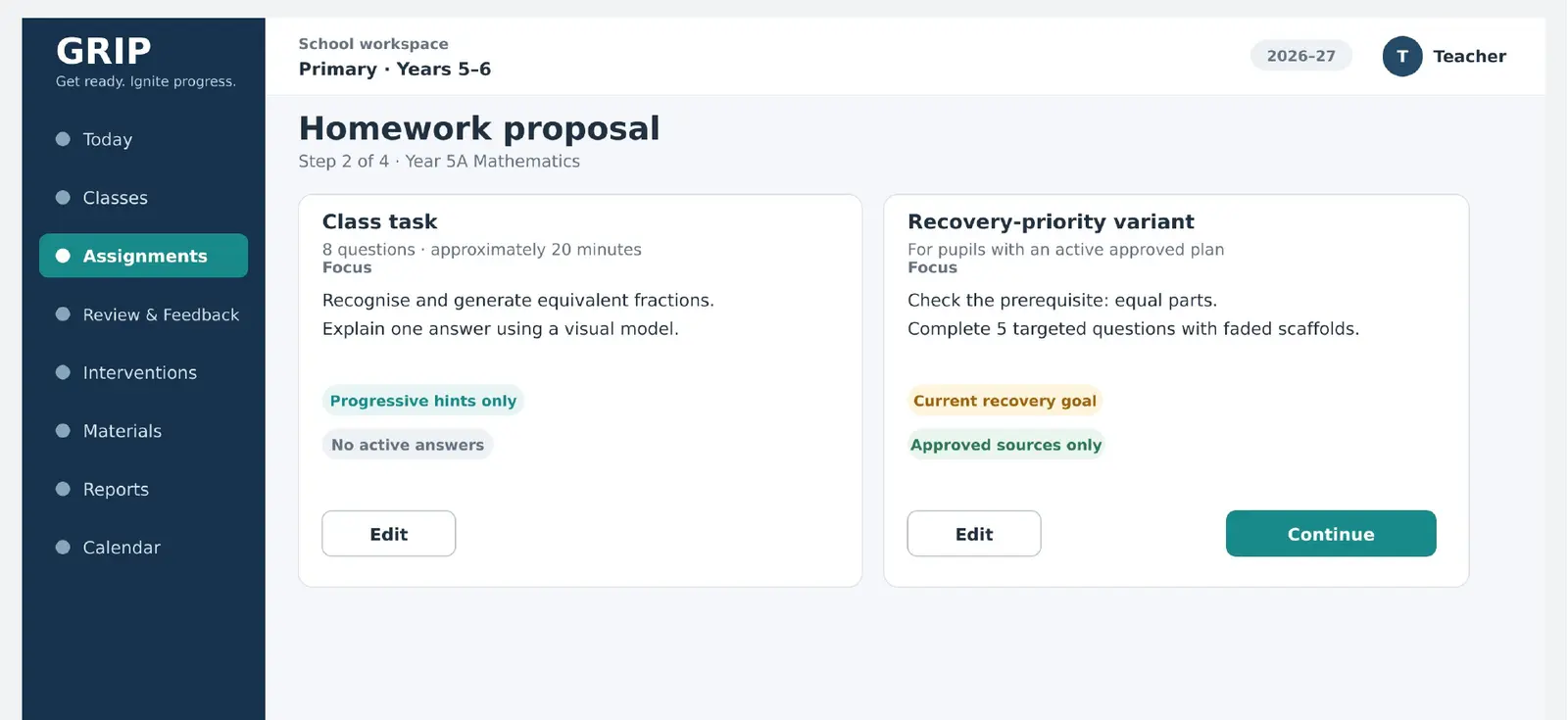
A school needs to know what informs the work its pupils receive. GRIP’s materials-first approach uses active official packs and school-approved resources as the starting point for teaching and homework.
This provides a practical basis for review. Educators can consider whether the material fits the curriculum, the examination route and the needs of the class. Approval is part of the educational workflow, rather than an assumption that every generated activity is suitable.
Give guidance that protects learner ownership
Productive support helps a pupil reason, attempt and improve. Hints before answers is a design principle intended to keep the learner actively involved. The amount of help should serve understanding and encourage progress towards independent work.
This matters when interpreting completed work. A polished answer alone cannot establish what a pupil understands. Correction, equivalent practice and later checks provide a more useful basis for discussion than completion by itself.

Keep people responsible for important decisions
Teachers retain authority over school content, formal interventions and high-impact educational decisions. GRIP supports their work by bringing information and actions together; professional responsibility remains with the school.
For Back on Track, that includes activation, review and exit. For routine learning, it includes interpreting evidence in context. A digital signal should begin a professional enquiry when needed, rather than close it without consideration of the learner.

Use information for an authorised purpose
The platform’s workspaces are organised around role and purpose. A pupil, parent, teacher and school leader have different reasons to access information and should receive the view appropriate to their work.
Implementation therefore needs clear school responsibilities: who reviews access, how family visibility is handled and how concerns are raised. These are part of making a connected platform useful and understandable to the community. Specific contractual and data-handling arrangements should be confirmed for the school’s deployment.
Respect assessment and access needs
Guided practice and formal assessment serve different purposes. GRIP includes controlled tests and exam-integrity controls within its stated approach. Schools should establish when assistance is appropriate, what conditions apply to an assessment and how evidence will be interpreted.
The accessibility target is WCAG 2.2 Level AA. A target is not a certification: schools should consider the actual experience of their users and include accessibility needs in implementation and review. Clear instructions and consistent navigation remain important throughout the site and platform.
Review the educational effect
Responsible adoption is an ongoing process. A school can review how teachers use the workflow, how pupils respond to guidance and whether interventions lead to retained understanding. Feedback from families and staff can identify where expectations or routines need clarification.
GRIP does not guarantee a grade, an examination pass or a particular school outcome. Its purpose is to support a more connected process in which people can act on evidence, maintain oversight and improve the support they provide.

A CLOSER LOOK
Questions & answers
Is AI output automatically a school decision?
No. Teachers and school leaders retain authority over content, interventions and high-impact decisions.
Is the accessibility target a certification?
No. WCAG 2.2 Level AA is a stated target. It should not be read as an independent certification or a guarantee for every deployment.
Where should a school confirm data arrangements?
The school should confirm the contractual, access and data-handling arrangements for its specific deployment during implementation. This overview does not replace those documents.

CONTINUE EXPLORING